
Human to Human
(ATS, this isn't for you)

I’m thrilled to share that, after a recent layoff, I’ll be dedicating myself full-time to what was previously a nights-and-weekends passion project: shitposting on the internet.
You can expect more memes, hotter takes, and significantly faster turnaround on thoughts I used to keep to myself.
Thank you to everyone who believed in me. This is a direct result of being given the gift of free time.
Kidding (somewhat)
But that gift of free time has given me space to reflect on my past accomplishments, what I want in my next role, and the values I’d love to bring to the next company I join.
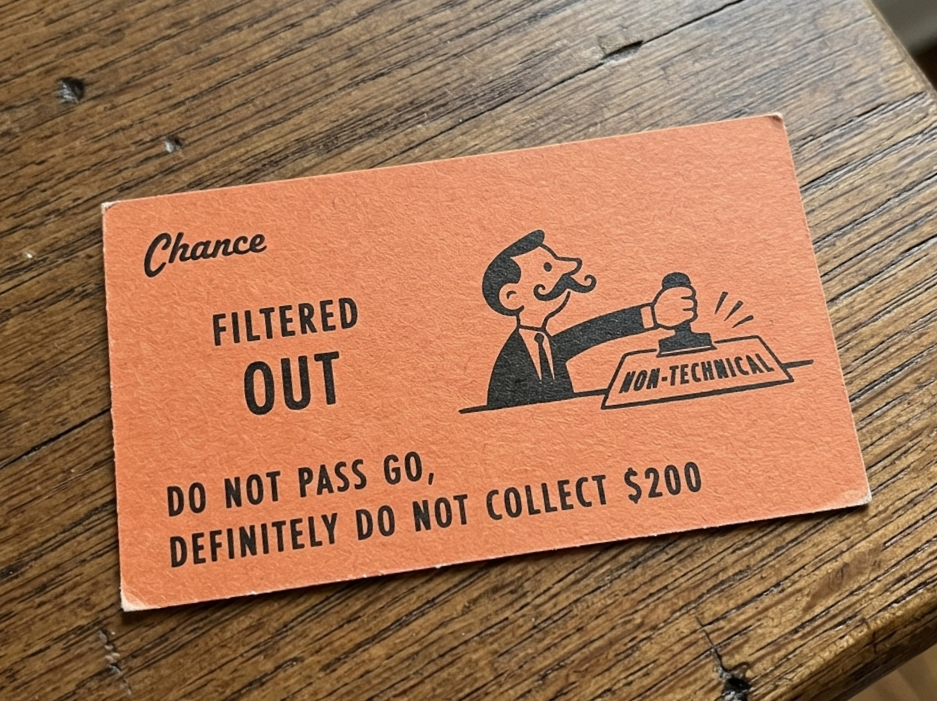
Do not pass Go. Definitely do not collect $200.
I am a non-traditional candidate in an increasingly saturated job market, and I may not fit the usual mold for an engineering leader. It feels like I’m swimming against the current, given my winding path to becoming a software engineering manager. This is nothing new— I’ve always had to work against this assumption, constantly proving my technical depth despite the results I’ve driven. I’m not here to complain about that. Plenty of research exists on job market signaling; I even used these signals (a CS degree or years of writing code) when I was hiring a developer for my last team.
Steve Jobs, 1994. Interview recorded by the Santa Clara Valley Historical Association
This signal, whether I had a name for it or not, has long been a source of insecurity. It’s not that I didn’t want to go to school, or learn how to code (I have tried, believe me), but at a certain point, I realized my strengths lie elsewhere. Strengths that can be rarer in tech, like translating the complex into the straightforward and bringing the less-technical stakeholders along. And I leaned into how I learn best: through doing, through leading.
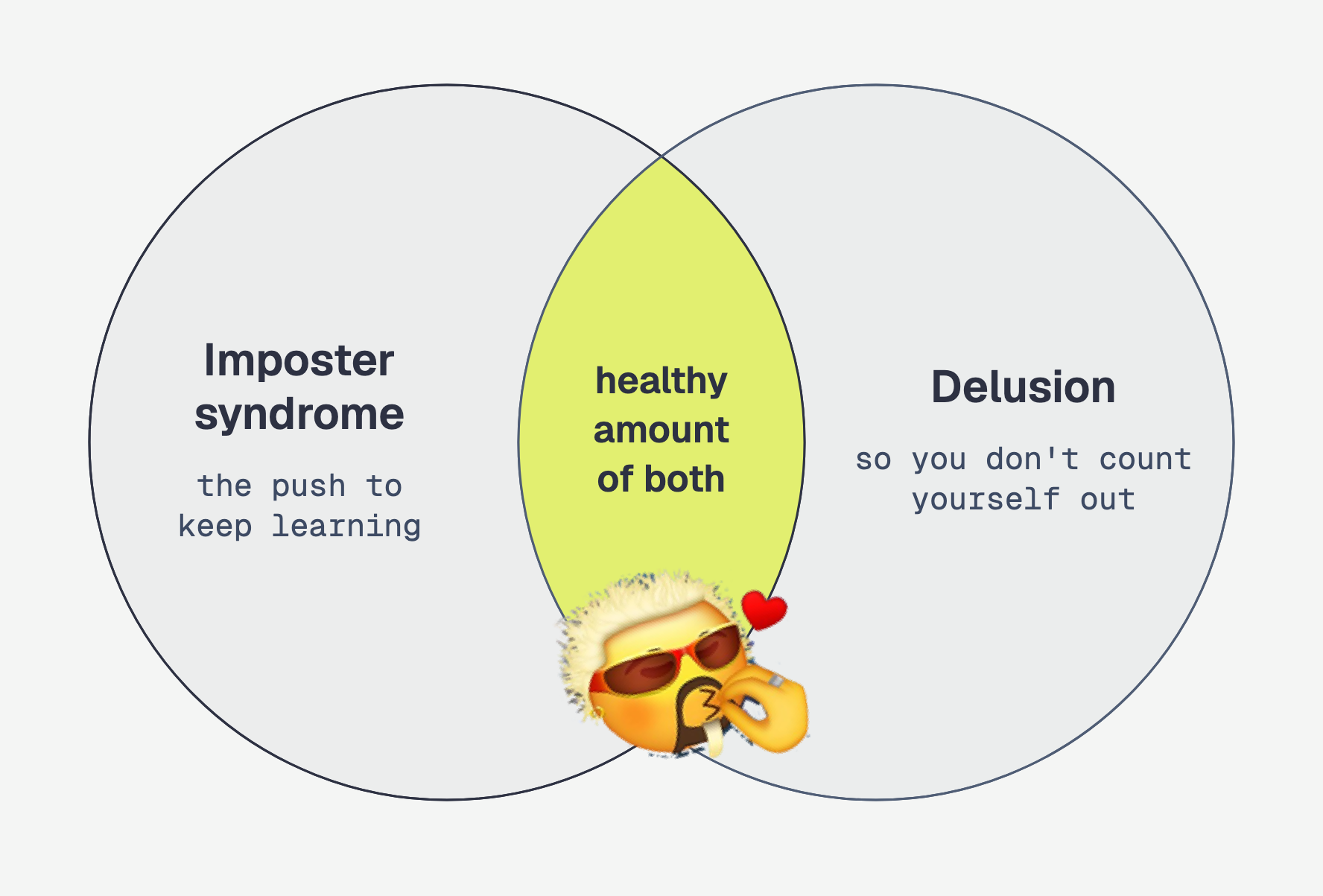
After a lot of self-work, I’ve come to the conclusion that in order to be successful, you need to have a healthy amount of imposter syndrome (to inspire the push to keep learning) and a healthy amount of delusion (at least enough to match the level of others, so you don’t count yourself out). I know the value I bring, and that I’m a damn good leader.
One thing you’ll learn about me is that I am a creator through and through. Creating things, design, is problem-solving in its purest form. And I love to problem-solve. It is the same muscle as software engineering, but through a different medium and with its own set of constraints.
New Doors
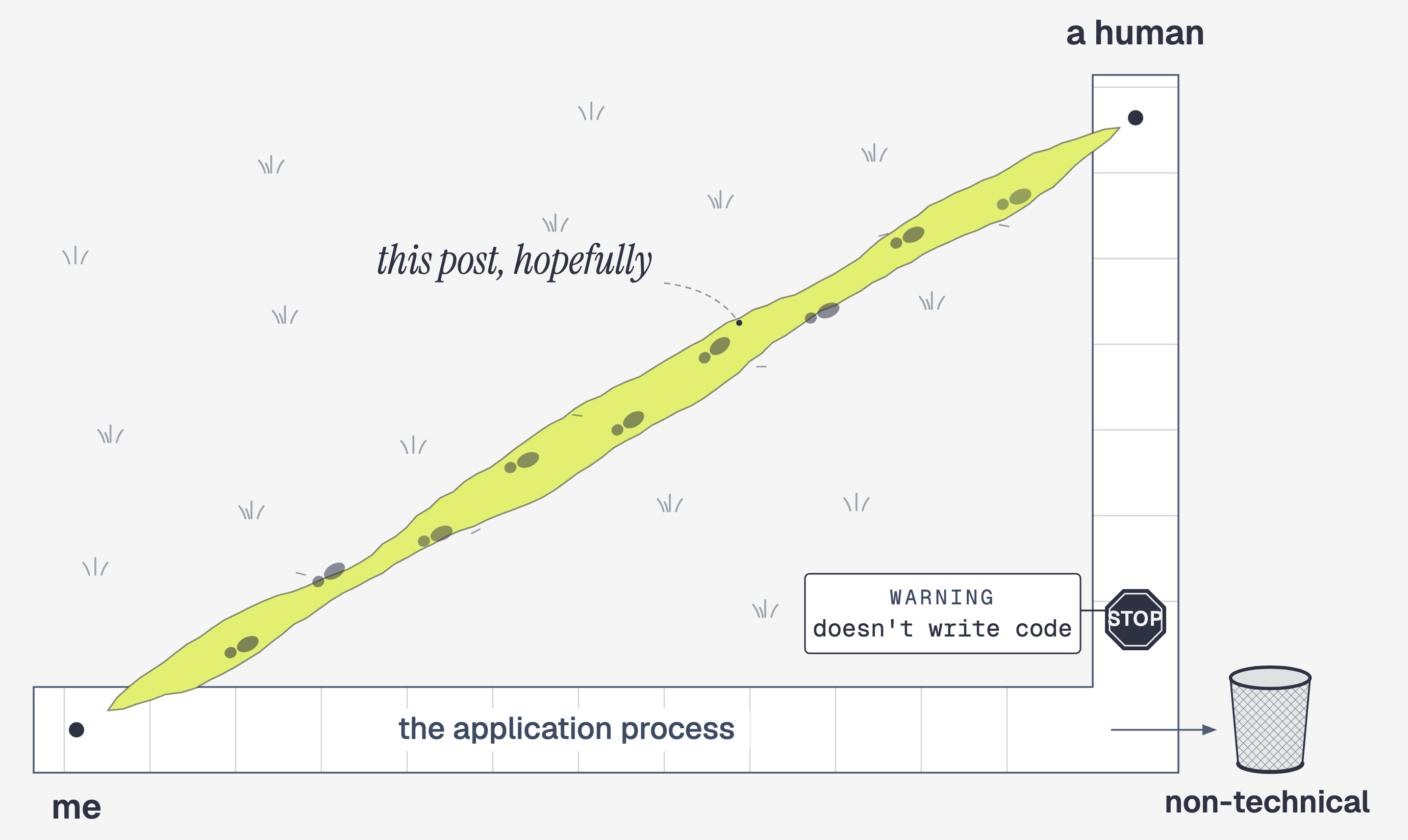
So I need to get past the applicant tracking system (ATS), because there’s a chance that, despite my best efforts to optimize, the “doesn't write code” flag will keep me from getting anywhere. If my background is non-traditional and I’m tackling the job hunt through traditional methods, then I think the only outcome is either being incredibly lucky or being disappointed a lot.
I need to get to a person, and the front door is locked. So what’s the move? Write a letter and hand it to a human (virtually, at least), calling out the problem (AI, specifically lazy AI use) and how it’s broken hiring. The creator in me decided that designing a new door would be much more effective than knocking harder.
A letter?! Such creativity! So avant-garde, and very Duchamp of me. As with any creative endeavor, it starts with an idea, hit some roadblocks and constraints (as frustrating as they are, I love them), and what was supposed to be a tongue-in-cheek "just between us" one-pager turned into a two-page correspondence that needed even more space, so it became this blog post. Rules are made up. And I know I must follow that spark.

Don’t Be a Meat Proxy
Oh great, here comes another AI-generated cover letter and resume, is what I imagine a hiring manager thinking when the letter lands. My original plan was to write the letter in a font AI can't read, but that’s proving difficult these days. What I really want is to communicate human-to-human, so we can talk about the weird AI-generated elephant in the room.

I think AI use is a competency. Like any competency, someone can be underskilled, adept, or overusing the skill. AI Slop is what overuse looks like.
Not all AI output is slop. Slop is the stuff that never passes the human judgment test.
“Should we be proud of our work?”
“Do we stand behind it?”
Skip that test, and we’re just a meat proxy for the AI. (I wish I’d come up with that brilliant phrase. Alas, credit goes to the anonymous owner of not-an-llm.com, also shout-out to Niklas Gruhn, and meatproxy.me)

I firmly believe AI is a wonderful tool. However, it is seductive in that it’s easy to picture a world where we don’t have to work. But the opposite is true. It can help increase velocity and productivity, but that means the work shifts to before and after the creation step. AI slop is the clearest indicator that work is being skipped. So yes, I think most people should use AI in their work. But it’s not an outsourcing tool.
(Rest in peace, em dashes and “it’s not X, it’s Y” statements— I loved you. Once powerful literary devices, now sadly a sloppy scarlet letter. You are survived by “delve,” “tapestry,” and “seamless,” whose overuse has underscored their demise. Your legacy is a testament to the ever-evolving landscape of modern prose. Honestly? Gone, but not forgotten. Just quietly flagged.)

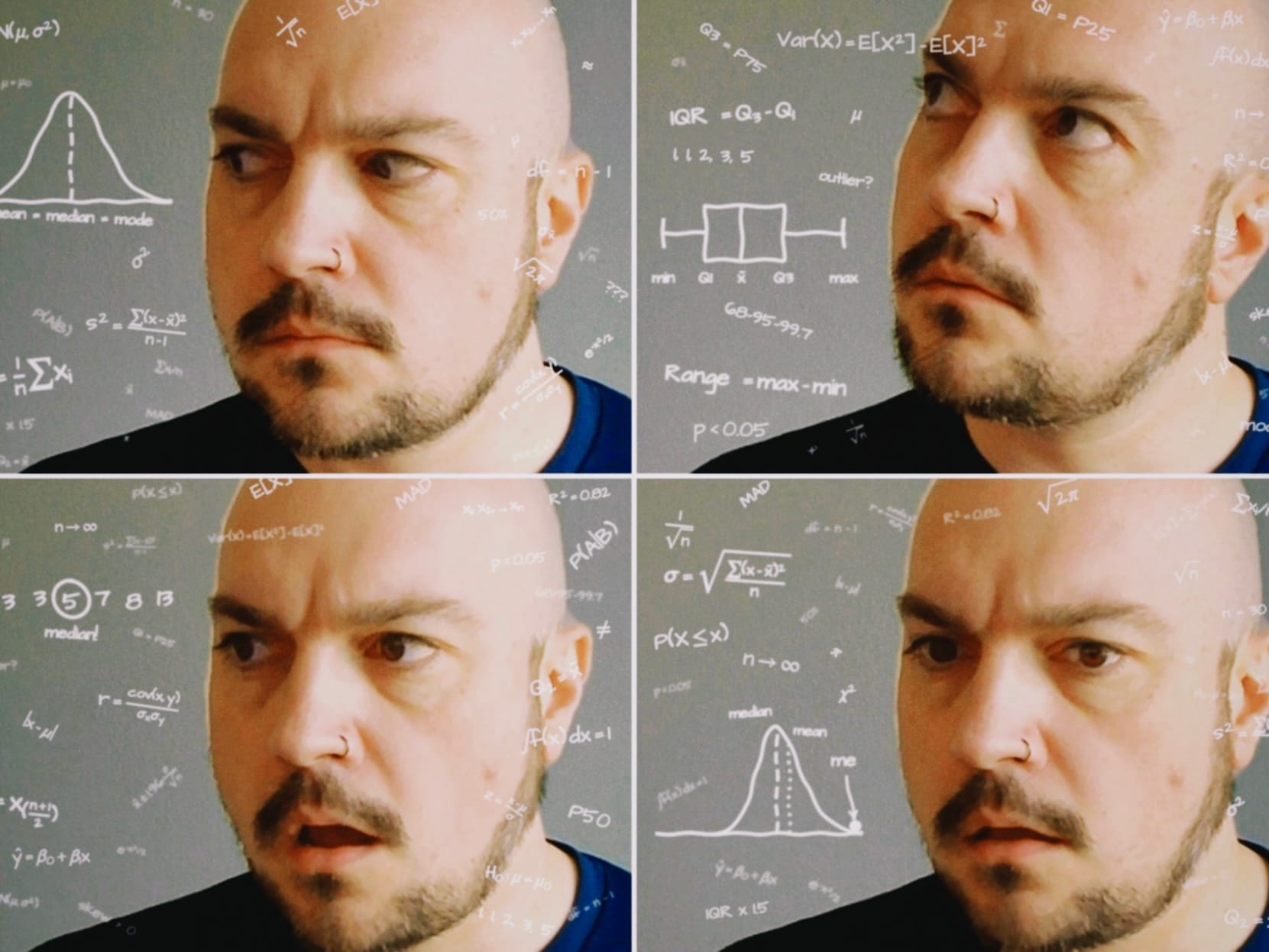
AI is, at a high level, just a fancy “prediction machine,” aiming to find the most probable response. Without care, it drags everything to the middle, lifting the bad ideas and flattening the good ones. The median is the status quo. There’s nothing special about it, and it’s easily reproducible. The care taken to marry the business, its workflows, the product, the user’s needs, the implementation, and the subsequent verification and observation was always the secret ingredient. Now it’s the whole recipe. The code becomes the result of the process, not the other way around.
I know my non-traditional path to engineering management probably excludes me from many search results companies might use to find the right talent. But if you filter for the median and hire the median, the results might be the same. Median.
In a normal world, maybe this screening method would be helpful. But look around today, and try to tell me the world is “normal.” Everything is vastly different from what it was 10 years ago, 5 even. I recently interviewed with someone, and they weren’t feeling well. They were off-camera the whole time while I was on. In the before-times, this concept would be insane. But today, it’s normal. And it wasn’t even a big deal.
The Long Way Around
I came up through design, Apple, and QA before becoming an engineering manager. That path is why, on paper, I’m “not a traditional technical manager.” I work well across design, product, and engineering, and I bring a testing-and-validation mindset to how teams build.
At Pax8, I led three teams through monolith decomposition and complex Kafka event-driven integrations, and I built a learning culture that made my teams early adopters of new technologies and ways of working. I understand the business, the code, the infrastructure, and the people, all without identifying as a developer.
Here’s what that looks like in practice. A few weeks ago, I wanted to get warmed up on Java basics for an interview. I did this the way I learn best: by building something. I’ve been working on an envelope budgeting app because everything out there is just way too much. I took the ledger at the heart of my app and worked with an agent to port it over to Java and Spring Boot (from TypeScript, Next.js, and Supabase). Before a single line of code was written, I wrote the rules. The ledger is the source of truth. The ledger is append-only. Every balance has to match its ledger. Every feature starts with a failing test. Defining the rules up front let me validate that none of them broke as we built. It gave my agent a clear picture of what’s correct.
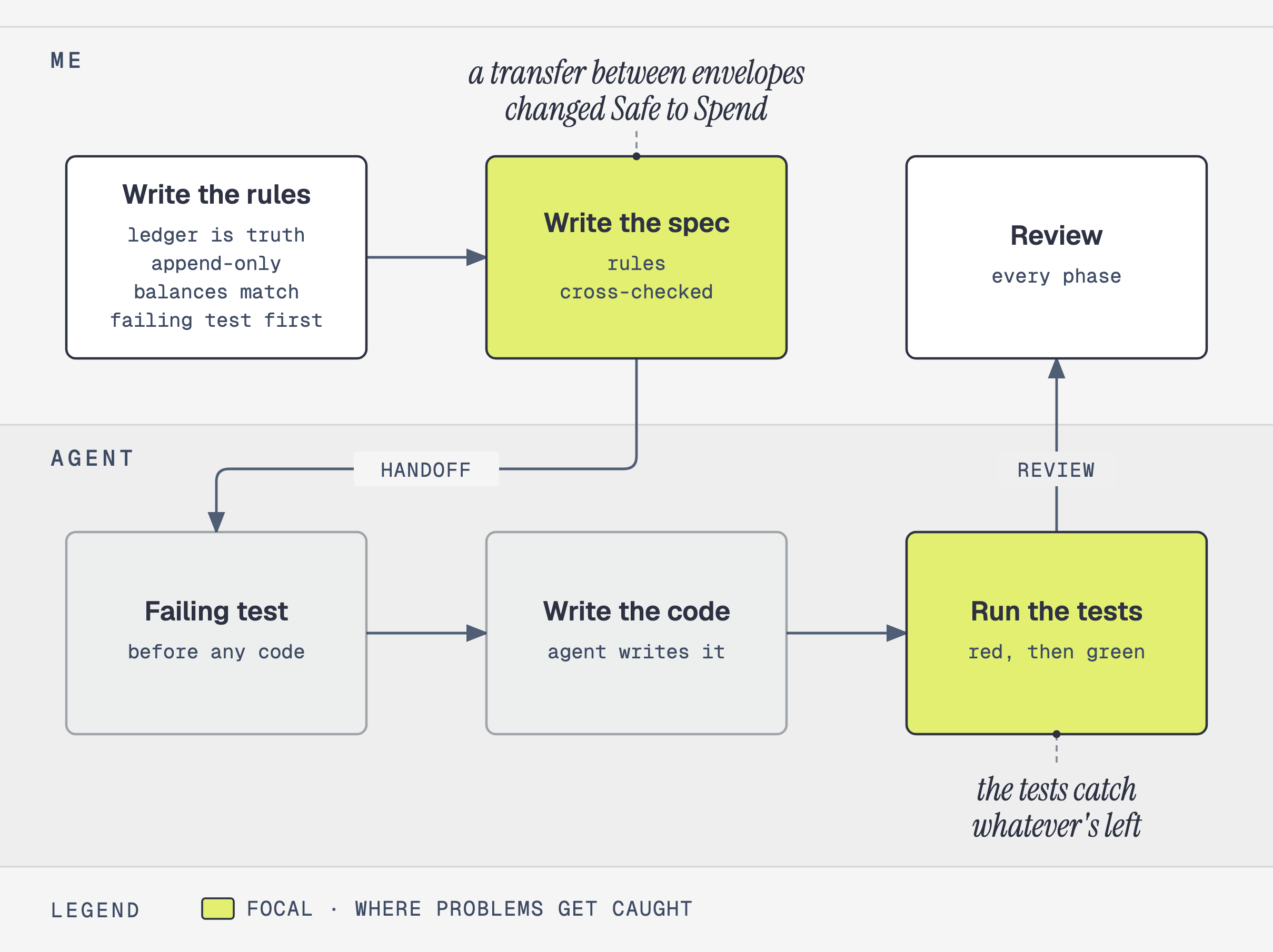
Writing the spec first forced each rule to be stated precisely enough to check against the others. This stage catches the logic contradictions, and the test stage catches whatever’s left. The spec surfaced that moving money from one envelope to another changed the Safe to Spend number, even though no money left the account, which could make you think you had more to spend than you did. Taking the time to establish a shared understanding of the app’s rules and functions is critical to working with AI, and equally important to building a team that can move quickly and with confidence
And moving quickly with confidence matters more now than ever, because nothing else is standing still. So to adapt to a future that will be anything but normal, I think it’s time to look beyond the prescribed shapes or cookie-cutters that worked in the past. Because we need to shed those ideas and orient ourselves around what’s coming. Fast.
As the world gets weirder, an engineering leader who hasn’t written production code, but knows the structure it stands on, isn’t so weird after all. Leaders who came up through code can spot trouble as it’s being written. Leaders who came up around it can spot trouble before the first line. There's value in both.
Ghost Font. [hover/tap to pause]
The silly guy, the non-traditional creative generalist, and the one who loves to see his team grow and succeed might just be the candidate you need, and the one the system will never find.
Did I pique your interest? Let's talk, human to human. 🫶
☞ https://www.linkedin.com/in/mitchell-lubbers/
✉ hire-me@himitcho.com