
Playing in Tune
Reflections on jazz, constraints, and creating space for teams to improvise
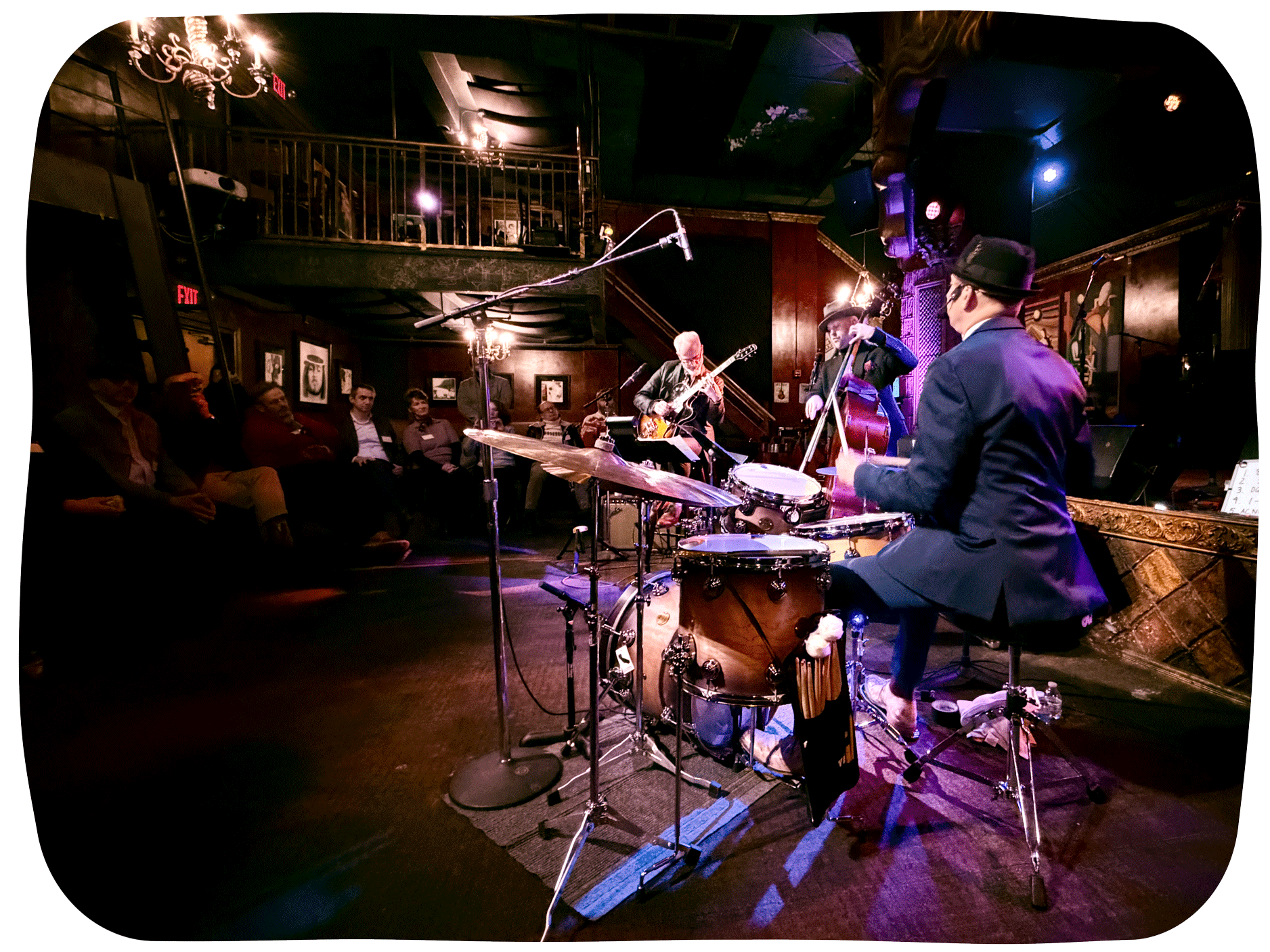
I’ve always had a deep appreciation for music, and have been a casual listener of jazz. From the smooth jazz station my dad always had on, to living around the corner from an iconic Denver jazz bar, to appreciating jazz’s fingerprints in electronic music, I figured I had a decent sense of what to expect from a workshop connecting jazz and leadership.
What I Thought Improvisation Was
As a creative person™ improv has been a bit of an enigma to me. My creative process can sometimes feel like the opposite of improvisation: meticulous observation, lots of thought, and then giving it space to “roll around in my head.” Over time, all of this led me to a conclusion: I had always thought that I was a ‘slow thinker.’ That was my label, anyway. My therapist called it internal processing, which reframed something I’d seen as a weakness into just… a different way of working. It was only recently that I had even recognized this as a strength rather than a weakness. Being able to “just come up with things,” let alone creative genius or something that moves people, on the fly, was wild to me. And not just that, improvisation seemed like you could take things wherever you wanted, like anything goes. That freedom, that ability to create something meaningful with no apparent constraints, felt like magic I didn’t understand.
Context as the Foundation
The magic, as it turns out, is that the three musicians in the Daniel Glass Trio are not bringing three distinct, unrelated ideas to the current song they’re playing; rather, they’re bringing their experience to a shared space. This space is an environment where many things converge to create a shared understanding. Constraints establish the boundaries. The sheet music provides the roadmap and establishes the key. The trio, the team, holds a common goal or a collective mission. Each individual brings their own unique set of experiences and abilities, all of which become part of the context. Once the context is established amongst the group, everyone can play around with it and experiment.
In the workshop, we went through an exercise to demonstrate this. For a group that was a mix of musicians and not, the first bit of context is simply establishing the beat. Then, once everyone was snapping in time, each person had a turn at scatting (those signature jazz vocalizations). And it sounded as you’d expect: each person bringing their own discrete ideas, trying to stand out rather than connect. Then Daniel explained the concept of listening and responding, building on the person in front of you. In the next run-through, each person iterated on the same theme, filtered through their own perspective.
Context is a word I think about a lot these days. We use it to define our ownership areas in a software org. I use it to understand the landscape as I learn new things. I use it for onboarding new team members. Or use it to frame tough conversations. You hear about it a lot when talking about effective AI use and engineering. Context is the shared language, the shared understanding, and the shared sense of purpose. Context is what must exist before improvisation can begin.
I’m seeing this in my own work right now. With a new team configuration, we’re still in that ‘establishing the beat’ phase: understanding how we each work, what our constraints are, and where we’re headed together. Only once we have that shared context can we start experimenting with how we actually get there.
The Return
But then, it snaps back into place. It returns to the sheet music. Back to the ‘head,’ to the melody, to what’s familiar. The tension and release—without one, you cannot have the other. The concept of ‘the return’ was not new to me; it’s something I’ve always felt, but I’ve never been able to put into words why it is so significant. But in the context of jazz and improvisation, the constraints that once felt like they were in the way, something to work around or push against, become a comfortable home to return to. Pushing the boundaries within a defined context is learning, it’s experimentation, it’s innovation. The return creates coherence.
What this looks like at work is psychological safety. The goal is an environment where the team feels comfortable enough to take on what’s uncomfortable, and the return makes it safe to experiment. You can push boundaries because you know there’s a baseline to return to. For me, this means talking about it. We talk about what went well, what didn’t, and what we might change if we could do something similar again, because we probably will. We talk about what’s awkward—before it gets even more awkward.
In my creative practice, improvisation shows up as curiosity: finding tools and techniques to translate something intangible into something real. A feeling, an idea, a spark that wants, sometimes needs, to be expressed. Something I learned about creativity (ironically, from a place that felt like the wrong constraint for me - art school) is that constraints are a source of creativity. The tighter the boundaries, like a limited color palette, a specific grid system, or a set time constraint, the more focused and coherent the result. Total freedom can be paralyzing; constraints give you something to push against, to work within. They force simplicity.
Jazz is a Conversation
All of this (the context, the constraints, the return) exists within a larger framework: jazz is fundamentally a conversation. At its most basic, a conversation is an exchange of ideas between two or more people, spoken in a language everyone is fluent in. It usually means both parties share a common goal (getting to know one another), and without listening and responding, the conversation goes nowhere.
But a good conversation requires more than just the mechanics. It requires trust. The willingness to be vulnerable, to build on what someone else started rather than waiting for your turn to speak. It requires fluency in a shared language, whether that’s musical vocabulary or a professional context. It requires presence: actually listening to what’s being said right now, not planning three moves ahead. And perhaps most importantly, it requires meeting people where they are. A great conversationalist (or musician) reads the room, senses the energy, and adjusts their contribution to what the moment needs rather than what they came prepared to say.
In the workshop, I watched the trio demonstrate this in real time. When one musician took the lead, the others created space. Supporting without overwhelming, listening for the right moment to respond. They’d probably played these songs many times before, but each performance carved a new path. They were listening to each other in the moment, adapting, channeling that creative spirit through a familiar structure to create something fresh. It was a conversation in motion.
All of this is not so different from leading a team, focusing on culture, and creating space and opportunity to learn. As a leader, my main goal is to provide the support and structure I wish I had throughout most of my career. Looking back, the leaders who truly understood me were the ones who engaged in conversation. They understood my motivations and what makes me tick, sometimes before I did. They listened, adapted, and created space for me to experiment. They helped me push against those comfortable boundaries, knowing there was a baseline to return to.
Playing in Tune
I’ve spent years seeing my process as the opposite of improvisation. I saw improvisation as something different, this ability to generate brilliance on the spot.
But improvisation isn’t magic. But that kind of freedom doesn’t come out of thin air. The Daniel Glass Trio has spent years learning their instruments, practicing scales, playing standards, and building a vocabulary of musical phrases they could draw from. The improvisation was possible because of all that preparation. The freedom came from the constraints they’d mastered.
My process isn’t so different. All that observation, thinking, and ideation that I used to mistake for slowness? That’s the preparation. Building context, learning the language, and understanding the constraints. And when the moment comes to create, to respond, to lead, I’m improvising. Working in what jazz musicians might call open form - structured enough to be coherent, loose enough to be alive.
This is what I want for my teams, too. Not constant improvisation for its own sake, but the kind that comes from strong foundations. Teams that have done the work of establishing context, building trust, and understanding their constraints. Teams that can experiment because they know what they’re returning to. That’s when the real innovation happens. That’s when we’re all playing in tune.