Chasing Originality Is Like Chasing Perfection
The wall isn’t an obstacle so much as a signal. It’s telling me it’s time to reframe my intentions.
I hit a wall. See if this cycle sounds familiar:
Have an idea → hyperfocus → curiosity → research → insecurity → wall → abandonment.
There’s something deeply satisfying about having an idea, working on it a bit, and then venturing out onto the internet to see how other people have tackled the same problem. It’s satisfying in the same way a Big Mac is satisfying. In the moment, it feels good. Reassuring, even. But almost immediately, it comes with a crash.
Seeing work that validates the idea brings a quick hit of pride. Seeing how polished, mature, or fully realized other approaches are brings something else entirely. Not motivation, but comparison. Not curiosity, but a sense that I’m already behind.
As someone who’s spent a lifetime making things and quietly wrestling with perfectionism, it’s taken me years to recognize the pattern. The problem isn’t that better versions exist. It’s that the moment I start looking outward, the work stops being about exploring an idea and starts being about proving it deserves to exist. Perfect becomes the goal. Progress stalls. The wall shows up.
This time, while I was banging my head against the wall, I paused and asked myself a different question: why does everything feel fine until I go looking for examples? What actually changes in that moment?
The biggest thing that changes is subtle but enough to derail: I move out of problem-solving and into interpretation. The work stops being about responding to a need I can feel, and starts being about anticipating what other people might expect. The question quietly shifts from “What helps me?” to “How will this be received?”
That shift is the wall.
I do want to eventually provide others with what I’m building, but it has to start with me. Every time I’ve tried to design from the outside in, I’ve recreated the same friction I was trying to escape. So here’s the reframe that helped: I’m building the system that actually works for me, because despite trying countless tools, none of them quite did.
That means letting early ideas exist without asking them to prove themselves. The only validation that matters at this stage is use. If I reach for something, and it helps, that’s enough. I’m not designing a “planner system” or shipping a perfect PDF calendar. I’m building a small set of tools that adapt as I do. They keep what matters visible when I need structure, and get out of the way when I don’t.
That reframe also helps me put into words a feeling I’ve held onto for a long time. I keep coming back to the line often attributed to Steve Jobs, who then gives credit to Pablo Picasso: “Good artists copy, great artists steal.” What’s funny is that the quote itself has been copied, reworded, and reassigned so many times that its origin is almost beside the point. We love it when something becomes an example of itself.
In a world with billions of people making things, chasing originality starts to feel a lot like chasing perfection. Both sound noble. Both are strangely paralyzing. Over time, creativity has made more sense to me as a problem-solving exercise instead. A response to constraints. A way of arranging familiar ideas to meet a specific need. The work isn’t about inventing something no one has ever seen before. It’s about noticing what’s missing, what’s frictional, and shaping something that fits. That reframe has been useful already. It’s helping me notice when I slip into seeking reassurance, pause, and return to the work when I feel stuck.
This blog—or more accurately, the act of writing it—forces me to gather my thoughts and put them somewhere. That structure helps me think things through in the foreground, while also giving my brain something to quietly work on in the background. Functional procrastination. With limited time, inspiration, and motivation, it can feel indulgent to direct energy here, but it leaves me far more satisfied than a Big Mac ever did.
As for what I’ve actually been working on and testing, most of it has been foundational. Typography with enough softness to complement handwritten notes. Date layouts that are quick to update, like a tiny calendar for a persistent month view and a reusable date template inspired by those perpetual rubber date stamps. A daily page for to-dos and cover pages for notebooks that take advantage of the reMarkable Paper Pro’s color screen.
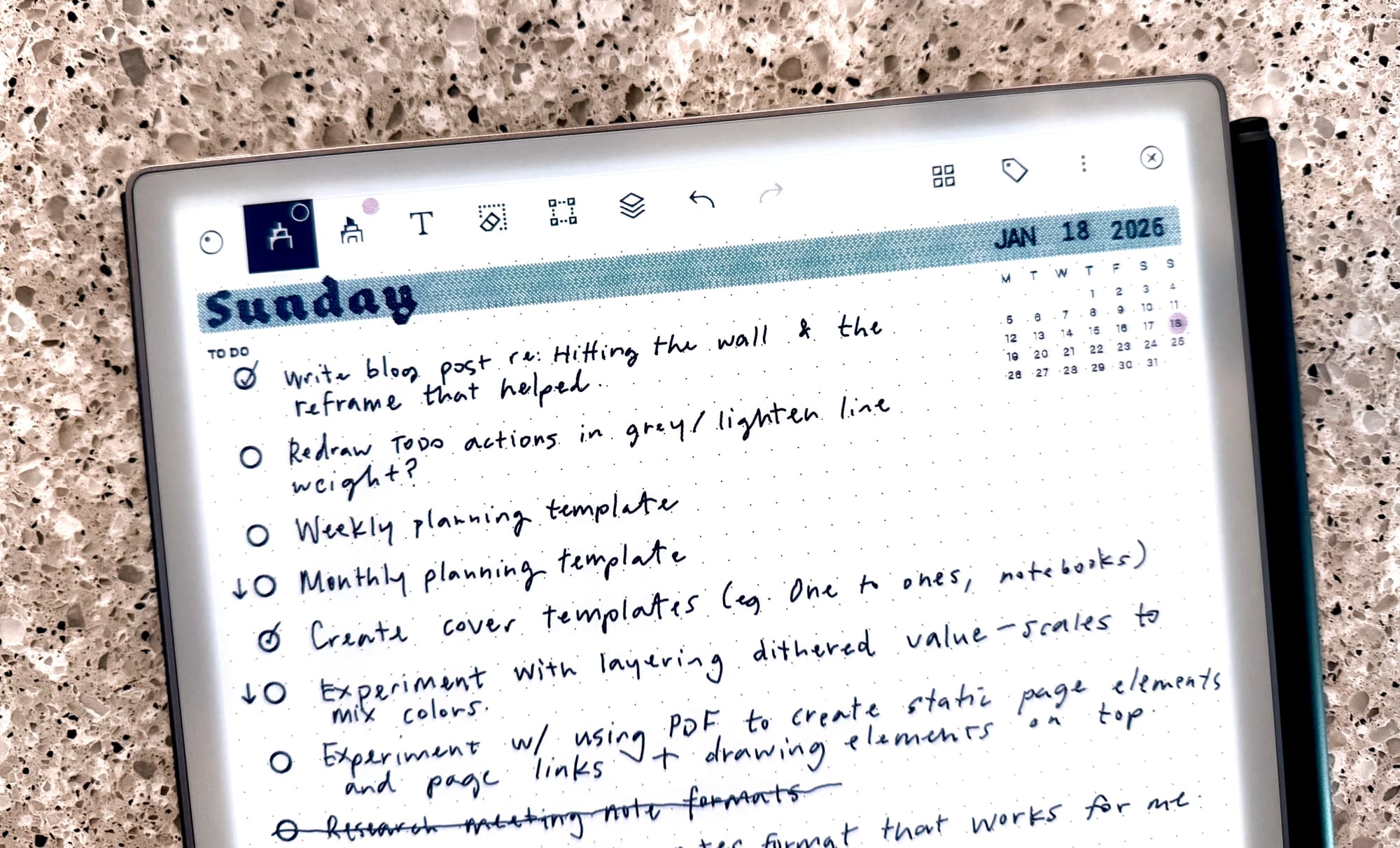
I’ll get into the details next, including screenshots, photos, and the tradeoffs behind each choice. For now, this feels like the right place to pause, reflect, and stop banging my head against the wall.